Who’s been stealing my lucerne?

As a little trial, I planted a small border of lucerne (alfalfa for those from the US) around one of my vegetable garden beds. The idea being that its longer roots will not interfere with the growth of any neighbouring vegies, we will gain the benefits of the plants nitrogen fixing abilities and we can also periodically chop it off and mulch the bed with it as a high quality mulch.

However, it seems that it too has attracted its own predator. Its been growing for several months now (sown 10th March) and every time when I think to myself I might give it a haircut tomorrow, the next morning when I come out someone/thing has beaten me to it.

My initial thoughts were grasshoppers/caterpillars, but I cant see any evidence of them (surely we’d spot a rogue somewhere on one of the plants?), so perhaps the only other thing it can be is our friendly hares. Our yard within which the vegetable garden is enclosed is fenced with dog proof mesh and I had thought it was also bunny/hare proof. But perhaps we have a juvenile hare that is managing to slip through. Makes a bit of a mockery of our fierce bunny hunting (chase anything that moves) dalmatians!

So what to do? I think some more frequent night patrols by the dallys might be in order – which might not be completely to their liking given that we are now in Winter and they really like their nice warms beds inside the house! 

Lucern Border 1  IMG_2330

Kale – Anything this green has got to be good for you!

We tried growing Kale last year… it grew.. slowly… largely due  to the rubbish soil we had (unimproved soil from a landscape yard) and also due to the constant barrage from grubs. I think we harvested about a dozen leaves from 6 plants. Most of the time it just looked pretty uninspiring. This year however I think we have nailed it! We have improved our soil (mushroom compost, biochar, blood and bone), installed vege nets, and hurrah – finally discovered the secret to abundance in the vegetable garden.

The next challenge is coming up with sufficient variety of recipes to eat the stuff. Current favourite is one from Nom Nom Paleo which involves cooking it in a pressure cooker. Quick and delicious. Another favourite includes garlic and anchovies and is also very yummy. Now that we finally can produce enough of the stuff to make it worthwhile cooking it, I shall begin a recipe hunt in ernest. I was also pleased to note that our local Woolworths supermarket was selling about 10 leaves for approx $5 the other day, so I am certainly getting my moneys worth from our own seed raised plants.

Shared bed with Kale in the front and sprouting Broccoli in the rear.

Kale Patch 1

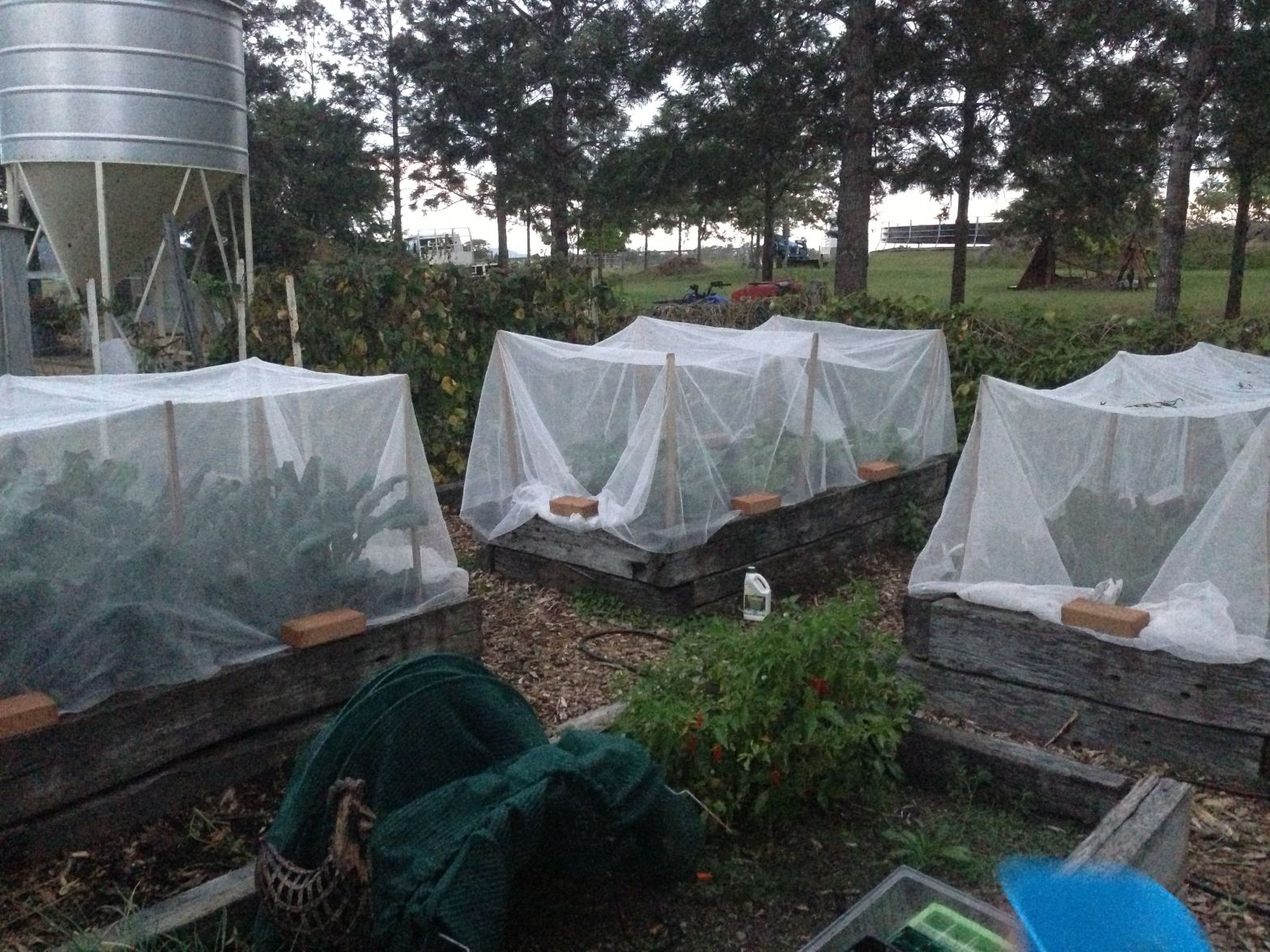
Vegie Nets – No bugs here!

This year we are trying vegie nets in our patch. In previous years it has been a constant struggle to protect our vegies from the endless attack of caterpillars, grasshoppers and other munchers and we have applied all sorts of chemicals and dusts. In our efforts to avoid all things chemical related in our food we stumbled upon vegie nets. We got just one to start with, and were so impressed by its effectiveness and simplicity we now have a couple more. It is so nice to not have to check the underside of every leaf for unwanted guests and our the kale we have been harvesting lately has been pristine. We found the best price for the nets on ebay. We just have them suspended over tomato stakes, but I have seen various other setups including poly pipe hoops and even just draping the nets over the established plants.

The Vegie Nets

Kale and Broccoli Beds

Biochar

I’ve been doing a bit of reading about the benefits of adding Biochar to soils and also to compost. Quite interesting reading if you have time. Good starting points Australia & New Zealand Biochar Researchers Network and also Black Earth Products. To start with I’ve got a 25L bag of Biocharpure (unfortunately I paid twice as much from another online garden supplies store… next time I will buy it direct from Black Earth Products).

As per the directions I’ve incorporated it into the top 10cm of soil in the vegetable garden beds at a rate of about 6 handfuls (50g approx per handful) per square metre, and also been including a couple of handfuls into the compost heap after the addition of high nitrogen material.

By adding Biochar to the soil I am hoping to improve moisture retention, improve the microbial population of the soil, increase amount of carbon in the soil and of course ultimately increase the amount we are able to harvest from our veggie patch.

We will look into this further also as a potential addition to our soils in our horse pastures when we start re-renovating them, but the veggie garden is a good place to make a start at least.

20130317-212350.jpg Picture of Biocharpure mixed with inoculant waiting for distribution. Apparently human urine is the inoculant of choice…. not what we used this time (Biocharpure comes packaged with its own inoculant!)

New Compost Bays

My husband has been hard at work the past few days creating some compost bays so we can start producing our own compost for enriching the vegie garden beds. We also have grander plans to do this on a larger scale for using on our paddocks, but small steps first…

We plan to use the abundant supply of stable manure (mix of horse manure and pine shavings) we have, as well cow manure (courtesy of Dasiy, Cadbury, Dora and Billy), lawn clippings, mulched/chipped garden clippings, weeds, vegetable plants that have passed their use by date and some chicken manure.

We went for a simple construction using some corrugated iron and a mix of old fence posts that we have lying around and some new timber for the slats at the front.

We also opted to construct it in our chicken pen to let our chookies do some of the hard work of turning it and also so they can enjoy the abundant supply of bugs etc. As you can imagine they have been very appreciative!

IMG_2035

IMG_2036

Egg Incubation Failure

One of the first steps in our plan to raise our chickens for meat was to get our first breeding stock and have a go at hatching some eggs. So we have recently purchased some Light Sussex pullets and a rooster, but being too impatient to wait until our own girls started laying, we also purchased 2 dozen Light Sussex eggs from a lady selling them on Farmstock, and introduced them to our nice shiny new incubator on February 1st.

However, of the 2 dozen eggs that were introduced, upon candling them at 7 days I had to discard more than half which were either clear or partially developed. Of those that were left I was dubious and so at the latest candling last night my fears have proven to be true and it looks as though from 24 potential starters we are now down to 2! (Maybe a 3rd but not particularly confident about that one).

Today is Day 18 and I have removed the auto-turner and increased the humidity in the hope of at least successfully hatching the remaining 2 hopefuls.

What went wrong? My initials thoughts are that I had too many eggs on the tray for the auto-turn device to cope with. Despite it saying it could incubate 24 eggs, I really think that they were just too packed in and so a lot of the eggs weren’t rolling sufficiently. Also there were several spotty/porous eggs which are not ideal for setting and 2 had cracks.

Fingers crossed at least that we do get 2 (or maybe even 3) to hatch in a couple of days and then it will be time to try again, tweaking a few things for the next setting.

I must also say that I think the incubator we have is marvellous (it’s a Maino See-Cube 24AXH and has been holding the temperature and humidity perfectly according to its digital displays. Much easier to use than my past experience with the old foam style incubators.), so despite the apparent failure on this first attempt, I do not at this stage hold the incubator entirely at fault but rather chalk it down more to operator error.


20130219-145227.jpg
Of 24 eggs that were originally put into the incubator, we only have 3 that have made the grade beyond candling at 17 days. This photo was taken today (Day 18) and I have just removed the auto-turn device and increased the humidity in preparation for hatching (hopefully).

Soil Improvement in the Vegie Garden

We have a number of raised beds in our vegie patch which we filled with “garden soil” purchased from a local landscaping centre. The soil has been in place now for around 2.5 years, and in that time we have had mixed success. We have used foliar fertilisers and also incorporated stable manure, chicken maure and cow manure, although the latter two has been fairly infrequent.

After a fairly lacklustre summer vegetable production we have decided that in addition to the searing temperatures, the condition of our soil was probably far from ideal. We are pretty lazy gardeners and I always look with some admiration at the tv gardeners who seem to have limitless energy and enthusiasm for composting and soil conditioning. We do have a lot of earthworms in the beds, so things can’t be too bad, however when you see a tough plant like silverbeet struggling along, you know that perhaps its time to take some action.

So, we have come to the realisation that in order to achieve our aims of growing our own produce with little or no synthetic fertilisers, as well as no synthetic pesticides we need to at take some steps to care for our soil. I studied agricultural science at university and I should have been onto our soil improvement long ago, but I must confess my absolute detest for all things soil related during my time at university. Having a beer at the uni rec club seemed like a much more important activity to undertake during soil science lectures…

In any case, with renewed enthusiasm we have ripped out today and bought a soil ph test kit, some dolomite lime (what is that – is it dolomite or is it lime or is it a combination of both? – something for me to research later), some garden lime and some blood and bone. I tested the soil in a couple of our raised beds, and to my surprise it came up as 6.5-7 . That has surely got to be impossible and so after a quick internet search I discovered that I should not have tested after heavy rain (which we have had for much of the day) (refer this Gardenote from WA Dept of Ag). So, I will wait until things dry out a bit and then try again. In any case, I threw some handfuls of dolomite lime and blood and bone on a couple of beds and dug it through as my impatience and guesstimates got the better of me (and we’ve got 11 raised beds so we need to get a few of them purring along in preparation for planting – we can tinker around with a few of the others while we learn to perfect the art of caring for our soil).