Three weeks ago we welcomed two new residents to our farm. Two little Tamworth piglets, who ultimately will be destined for the freezer, but in the meantime we’ll give them a good life and use their natural talents to help work over some of the harder packed areas of soil in our horse paddocks.
We were fortunate to find a local farm that breeds a small quantity of piglets each year for their own purposes, selling the surplus. Prior to arriving at our farm the pigs had been roaming freely across their breeders farm, so we thought it best to begin with some training to accustom the little guys to electric fencing which they will be housed behind as we rotate their small paddocks around.
We found a blog post on the Milkwood Permaculture site which detailed how they trained their piglets to respect two strands of electric fence (a technique they garnered from Polyface farms), and so we set up a similar triangular training paddock here on our farm which worked spectacularly. We probably went a bit overboard with the height of the electric fence at the front but we weren’t sure of their jumping capabilities!
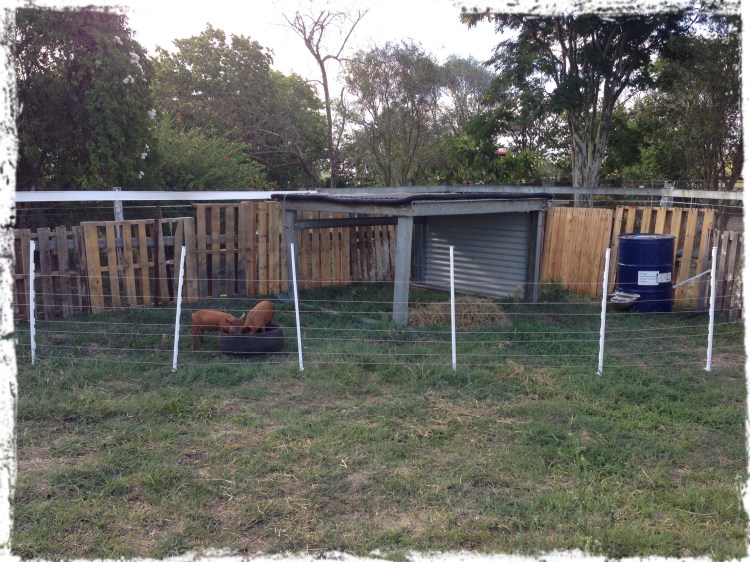
It really only took a day for the piggies to understand the electric fence concept, but to be safe we kept them in this paddock for just under a week, before moving them on to a new section of ground where they were completely enclosed with electric fence (pictured below).

We bought the electric fencing energiser, posts and wire from ebay as in our experience, the premium name brand electric fencing products such as Gallagher, Speedrite etc last no longer than the cheap Chinese imports (and in reality they are all probably coming from the same/similar factories in China anyway). Everything was delivered within a couple of days with free shipping so can’t really argue with that. The energiser we have for the pigs is solar powered so allows the paddock to be located wherever we please, without being reliant on being in contact with the main fencing system of the farm.
We have also got a small solar powered pump which we can use to access various dams to create nice mud patches for the pigs to work over and also to top up their water drum with.
In terms of feed, we already purchase bulk horse feed pellets (Barastoc Breed N Grow) and keep them stored on our farm in a silo. Although there might be a marginal gain to be had by feeding them on a strict pig grower ration with a slightly more optimal amino acid profile and lower fibre content, in reality for us, we are not trying to push for optimal growth rate for any market requirement, and it works out far more economical for us to use the feed that we buy in 4t loads instead of small 25kg bags. The protein content is satisfactory at 17% and really the additional bulk is probably insignificant anyway given that our pigs have free access to pasture (which they LOVE even though it is a bit miserable at the moment due to the prolonged drought being experienced over most of Queensland).
 Brookland Ridge Farm
Some good photos! We can’t use electric fencing because we have heavy rain here. Good post (y)
LikeLike
Thanks for your post. I read the Milkwood post before coming here. Your photos look great and I think it was a good idea to feed the pigs bulk food – provided they can get all of the nutrients they need. Hopefully in the future we will have a couple of pigs too!
LikeLike